
21
Jul
Property managers, commercial landlords, and facility directors across the Greater Toronto Area face rigid operational pressures. Municipal code enforcement and insurance risk assessments are tighter than ever. Commercial steel stairs, fire escapes, loading dock guardrails, and access ramps are safety-critical installations. When a municipal inspector flags an exterior steel guardrail or an insurance auditor notes structural movement, facility operators face an immediate liability risk. Municipalities actively enforce the updated edition of the Ontario Building Code (OBC), which became mandatory for all enforcement actions following the expiration of provincial transition periods.
Patching up code failures using uncertified local handymen does not satisfy legal mandates. Under the updated OBC and CSA Standard S16 (Design of Steel Structures), structural steel fusion welding must be performed exclusively by an organization certified to CSA W47.1 standards. Hiring non-certified crews leaves property owners exposed to liability and risks immediate project rejection by local building departments.
Harsh Southern Ontario winter freeze-thaw cycles, aggressive road salt application, and heavy operational wear degrade structural steel over time. Property owners should watch for these five specific indicators that steel guards and railings violate the Ontario Building Code, along with the precise technical solutions required to achieve full compliance.
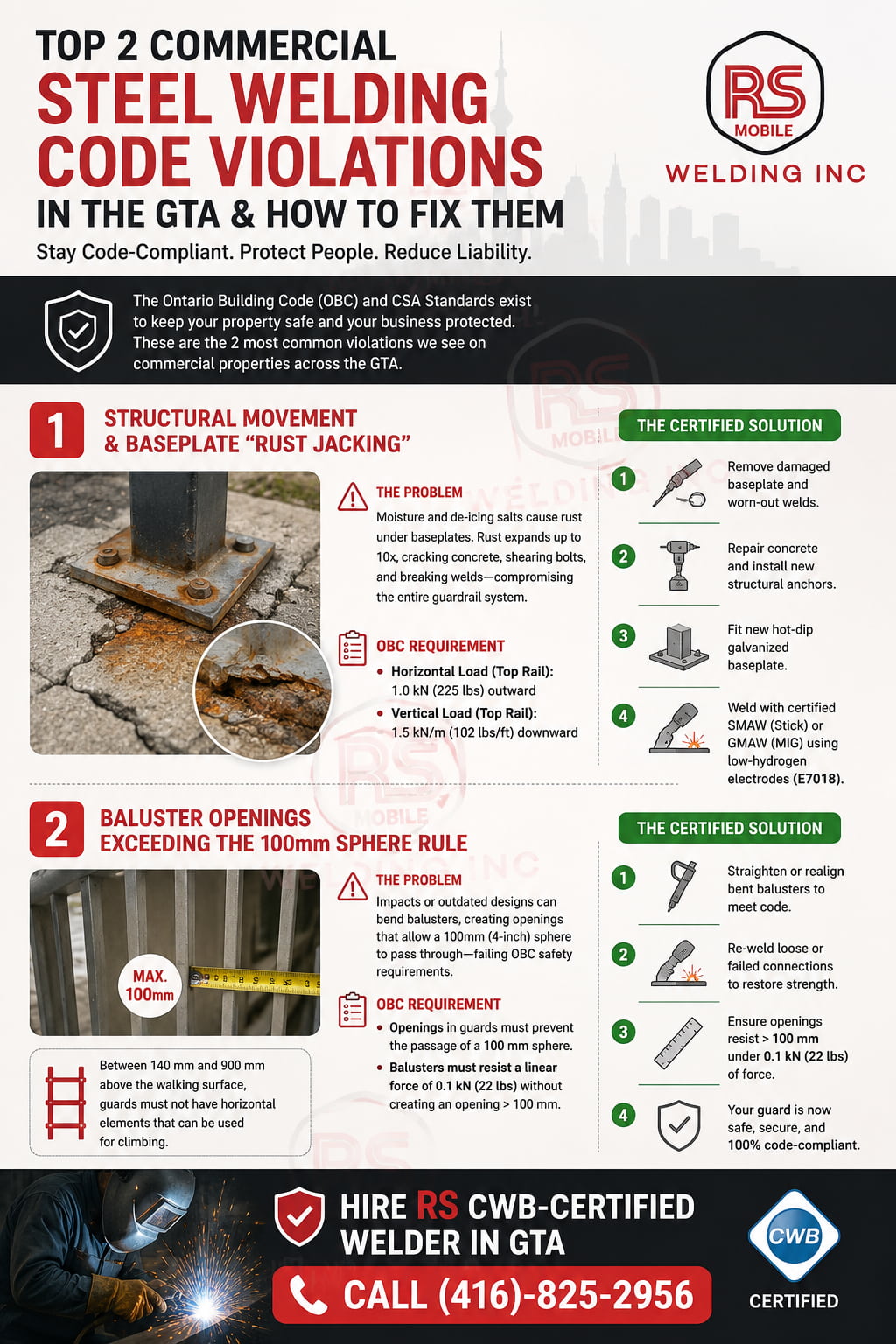
1. Structural Movement and Baseplate “Rust Jacking”
The most prevalent structural failure on GTA commercial properties occurs where exterior steel guard posts meet concrete walkways, parking structures, or retaining walls.
The Problem
Exterior baseplates endure constant exposure to water pooling and winter de-icing chemicals. Over several seasons, moisture penetrates the microscopic gap between the steel baseplate and the concrete surface. This induces heavy oxidation beneath the plate.
As steel rusts, it expands up to ten times its original thickness. This physical phenomenon, known as rust jacking, exerts immense upward pressure on the anchoring assembly. The expanding rust shears anchoring bolts, cracks the surrounding concrete substrate, and breaks the throat of the structural fillet weld connecting the post to the baseplate.
If a guardrail wobbles, deflects, or exhibits visible orange staining spilling from beneath the baseplate, its load-bearing capacity is compromised.
The OBC Code Violation
According to OBC Division B, Part 3 (and Part 9.8.8.2), guardrails must withstand substantial design loads without sustaining structural failure.
| Load Component | OBC Requirement |
| Horizontal Load (Top Rail) | Must resist a concentrated force of 1.0 kN (225 lbs) applied outward at any point. |
| Vertical Load (Top Rail) | Must resist a continuous downward force of 1.5 kN/m (102 lbs/ft). |
When rust jacking destabilizes a post base, the assembly cannot support the weight of an adult catching their balance during a slip, resulting in an immediate code infraction.
The Certified Solution
Fixing this issue properly does not require completely removing the concrete or discarding the entire railing system. A mobile team certified to CSA W47.1 can resolve the failure directly on-site:
- Step 1: The technician uses carbon arc or mechanical gouging to cleanly sever the compromised baseplate and fatigued weld metal from the vertical post.
- Step 2: The damaged concrete section is cored out or repaired, and new heavy-duty structural anchoring bolts are set.
- Step 3: The technician fits a brand-new, hot-dip galvanized steel baseplate.
- Step 4: Using code-compliant SMAW (Stick) or GMAW (MIG) procedures with low-hydrogen electrodes (such as E7018), the welder executes a continuous, structural fillet weld to fuse the existing post to the new baseplate, restoring factory-spec load capacity.
2. Baluster Openings Exceeding the 100mm Sphere Rule
Older industrial and commercial properties across Toronto, Mississauga, and Brampton often feature custom metalwork designed under outdated municipal frameworks.
The Problem
During routine property updates or ownership changes, local building departments re-inspect these spaces. A very common point of failure involves the open space between vertical balusters (pickets) on exterior balconies, mezzanine platforms, and open staircases.
Over decades of service, commercial steel railings experience physical impacts from delivery carts, heavy equipment, or minor vehicle contact. These impacts bend balusters out of alignment, stretching the gaps between them. In other instances, original architectural designs featured wide decorative spacing that no longer meets modern public safety thresholds.
The OBC Code Violation
To prevent injuries and falls in high-traffic public spaces, the building code enforces strict geometric and structural limitations on openings within guards.
According to OBC Sentence 3.3.1.17. (and Section 9.8.8.5.), openings in any guardrail protecting a drop of more than 600 mm must prevent the passage of a solid 100 mm (4-inch) sphere.
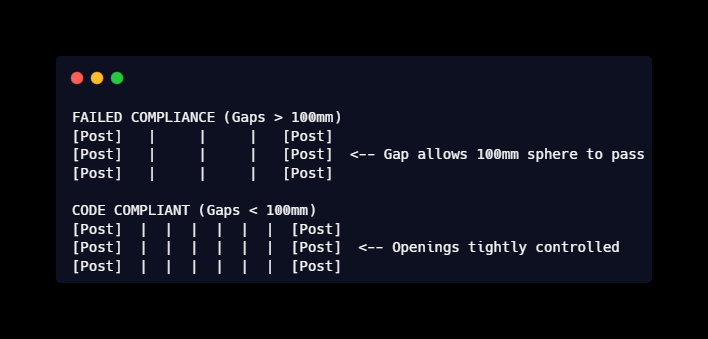
However, the updated code introduces a critical mechanical testing requirement: the vertical balusters must resist creating an opening larger than 100 mm even when subjected to a linear force of 0.1 kN (22 lbs). Municipal inspectors verify this by applying pressure directly to the pickets.
If bent steel or failed welds allow the balusters to flex past this threshold, the entire guard fails the safety audit. Furthermore, the code mandates that between the heights of 140 mm and 900 mm above the walking surface, the guard must not feature horizontal elements that could facilitate climbing.
The Certified Solution
Instead of ordering a costly new custom railing system, facility managers can address this layout failure through structured on-site remediation:
- Modifying the Structure: Welders introduce intermediate vertical steel balusters directly into the wide gaps to close the distance.
- Execution: Using precise gas metal arc welding, the technician fuses new matching steel rods or square tubing to the top and bottom structural channels.
- Finishing: The joints are ground smooth and treated with zinc-rich cold galvanizing compounds to match the existing asset, bringing the installation up to modern code quickly and cost-effectively.
3. Insufficient Guard Height on Raised Commercial Decks and Platforms
Changes made to the Ontario Building Code introduce strict structural updates that commercial operators must follow.
The Problem
Several commercial properties feature raised concrete pads, shipping docks, mechanical equipment platforms, or outdoor employee break areas that sit well above the surrounding grade. If these platforms were installed years ago, they might feature standard 36-inch (914 mm) railings.
When these properties undergo renovations requiring a building permit, municipal inspectors evaluate the existing guard heights against modern standards. If the platform height triggers a higher risk classification, older 36-inch railings are flagged immediately as code violations.
The OBC Code Violation
The minimum height requirement for an exterior guard depends entirely on the distance to the surface below:
- Part 9 Residential / Light Commercial: For platforms sitting between 600 mm and 1,800 mm above grade, a 900 mm (36-inch) guard is acceptable.
- Part 3 Commercial / Multi-Residential Mandate: If the drop to the surface below exceeds 1,800 mm (5 feet 11 inches), or if the installation falls under general Part 3 commercial classification, the guard height must be a minimum of 1,070 mm (42 inches).
This height must be measured vertically from the finished floor surface to the absolute top of the guard rail. A 36-inch rail on a high-clearance loading dock or rooftop HVAC service platform represents a direct compliance failure.
The Certified Solution
When height extensions are required, complete demolition is rarely necessary. Mobile structural welders can implement an engineered height extension:
- Extension Integration: Technicians source matching steel structural tubing and cut extension sleeves.
- Welding Procedure: The top cap of the existing rail is removed, internal reinforcement sleeves are inserted, and the new extension sections are fitted.
- Code Alignment: The joints receive deep-penetration welds to ensure the extended posts maintain the full 1.0 kN horizontal point-load capability required at the new, higher leverage point. The top rail is then reinstalled and seamlessly blended.
4. Galvanic Corrosion and Failed Dissimilar Metal Welds
In the GTA commercial sector, facility managers frequently encounter structural failures caused by improper material pairings.
The Problem
To lower costs or achieve specific architectural styles, contractors sometimes mount aluminum decorative panels, stainless steel cables, or specialized ironwork directly onto existing structural carbon steel frames.
If these metals connect without appropriate isolation, or if an unqualified welder uses standard steel filler wire to join different alloys, a rapid chemical breakdown occurs. When moisture and winter road salt cover the junction, it creates an unintended electrical circuit. The less noble metal (typically the aluminum or the weld boundary itself) undergoes rapid galvanic corrosion.
Within a few seasons, the metal surrounding the weld turns into a brittle, powdery oxide. The joint looks intact from a distance, but a firm impact can cause the connection to snap completely.
The OBC Code Violation
The building code addresses material performance directly under OBC Section 1.2.2. (Materials, Appliances, Systems, and Equipment): All materials used in structural assemblies must be free from defects and possess suitable durability for their intended environment.
A weld joint experiencing active galvanic degradation cannot meet the performance mandates of CSA S16. It fails to guarantee the required safety margins for high-occupancy commercial settings.
The Certified Solution
Resolving metallurgical contamination demands expert, certified intervention:
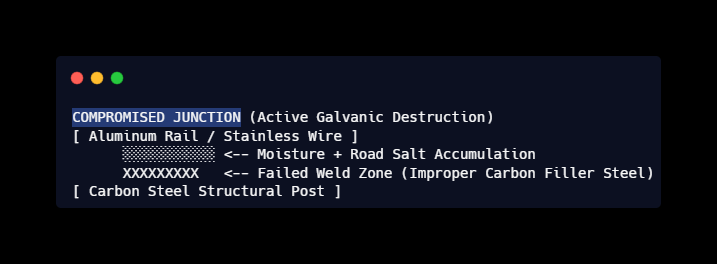
- Extraction: The technician cuts back the contaminated weld zone until they reach clean, unaffected structural base metal.
- Material Selection: If a steel-to-stainless connection is structurally required, a certified TIG technician utilizes specific high-alloy filler metals, such as ER309L, which is specifically formulated to join dissimilar steels without creating brittle zones or inducing accelerated corrosion.
- System Design: Where structural aluminum meets carbon steel, the team fabricates custom bolt-on mechanical connections utilizing non-conductive isolation pads and stainless steel fasteners, completely breaking the galvanic pathway.
5. Non-Compliant Stair Handrail Continuity and Grip Profiles
Property managers often confuse guards with handrails, but the building code evaluates them as two separate safety systems with unique performance requirements.
The Problem
A guard prevents a user from falling off an edge, while a handrail provides a continuous, graspable surface to hold while moving up or down a staircase.
Common compliance issues on commercial properties include:
- External steel staircases where the handrail terminates abruptly at the bottom step instead of extending past it.
- Handrails constructed from wide, flat steel bars (like a 2×4 steel channel) that a human hand cannot wrap around during a trip or stumble.
- Heavy paint accumulation or rough, unground weld repairs that snag fingers and interrupt a continuous grip.
The OBC & AODA Violations
On commercial properties, accessibility compliance is evaluated alongside structural stability. The safety guidelines within the code and the Accessibility for Ontarians with Disabilities Act (AODA) are exceptionally strict regarding handrail geometry:
- Continuous Extensions: Handrails must be continuous throughout the entire length of the stair flight. On public ramps and stairs, the handrail must extend horizontally for at least 300 mm (12 inches) beyond the top riser and continue to slope for the depth of one tread beyond the bottom riser. Abruptly ending a rail creates a major non-compliance hazard.
- Wall Clearance Standards: Under AODA design frameworks, handrails mounted to walls must maintain a continuous clear space of not less than 50 mm between the handrail and the wall surface. This ensures individuals with limited mobility can maintain a secure, uninterrupted grip without scraping their knuckles.
- Graspability Mandate: The rail profile must be easily graspable. A round steel pipe profile must have an outside diameter between 30 mm and 40 mm on accessible routes. If the rail uses a non-circular shape, the perimeter must measure between 100 mm and 155 mm. Flat, wide steel channels fail this requirement instantly.
The Certified Solution
Bringing non-compliant handrails up to code requires precision custom fabrication performed right on-site:
- Extension Integration: Welder fabricates custom terminal extensions (such as safety returns that loop back into the wall or post) to eliminate open rail ends that could snag clothing.
- Grip Remediation: If the existing top rail is ungraspable, the technician mounts a secondary, compliant 40mm round steel handrail to the inside face of the guard structure using code-compliant offset brackets.
- Finishing: All joints are welded continuously using smooth gas tungsten arc welding (TIG), then ground flush down to a clean finish, providing a safe, reliable, and fully compliant grip surface.
The Legal and Financial Risk of Non-Certified Welding
When a commercial property infrastructure asset fails, property managers face immense pressure to minimize repair expenses. This financial pressure leads many to hire general property maintenance handymen or uncertified welders operating out of residential trucks. However, in Ontario, this route carries severe legal and financial risks.
Documented Certification Compliance
The CWB Group administers the CSA W47.1 certification. This standard guarantees that a welding business operates under verified welding procedures data sheets (WPDS), utilizes fully tested, code-compliant equipment, and employs technicians who undergo rigorous practical testing every two years.
When a company holds this designation, every weld executed on your property is backed by documented, legally binding quality assurance standards.
The Hidden Hazards of Uncertified Labor
Hiring an uncertified welding service introduces substantial liability risks to your business operation:
- Insurance Voiding: If a commercial fire escape or loading dock gate collapses under load, insurance adjusters will investigate the repair history. If they discover structural modifications were executed by a firm lacking CSA W47.1 certification, the insurance provider can void the liability policy, leaving the property owner directly responsible for injury claims.
- Municipal Order Compliance Failures: GTA building inspectors maintain authority over structural safety. A repair executed without documented, certified welding procedures can be rejected on sight, resulting in a formal Order to Comply and forcing you to pay for the work a second time to have it done correctly.
- Hidden Welding Defects: Uncertified operations often use standard consumer-grade welding equipment that cannot achieve proper heat input control or deep root penetration on thick structural steel. This leads to severe hidden defects like lack of fusion, cold lapping, or hydrogen cracking—welds that look fine under a layer of paint but snap instantly under real-world load conditions.
Zero Downtime: Mobile Logistics and Inspector Sign-Off
For commercial properties, logistics hubs, and retail plazas, repairing a guardrail cannot mean halting business operations or blocking critical shipping lanes.
Independent On-Site Operations
Professional mobile welding units function as completely self-contained structural fabrication shops. Equipped with heavy-duty, engine-driven generators, these mobile rigs require zero connection to your building’s electrical grid.
Whether working on a remote parking deck, a secure rooftop HVAC platform, or an active warehouse loading dock, technicians complete deep-penetration structural welds independently. This eliminates long operational delays and avoids running high-voltage extension cords through public spaces.
Closing the Compliance File
Executing a high-quality weld is only half the battle; closing the compliance file with city officials requires proper documentation.
When you hire a CSA W47.1 certified welding service, you receive a comprehensive quality assurance paper trail. This includes formal Welding Procedure Data Sheets (WPDS) and valid CWB welder qualification records. These certified documents give municipal inspectors and insurance adjusters concrete proof that the structural modifications meet Ontario’s highest legal safety standards, allowing you to settle code orders quickly and maintain your property coverage.
Proactive Commercial Property Facility Audits
To manage infrastructure assets effectively, facility directors should implement a bi-annual structural safety walkthrough. Catching metal fatigue early prevents minor issues from escalating into expensive, emergency structural compliance orders.
The Facility Manager’s Weld Inspection Checklist
Use this quick framework during your next asset walk:
- Anchor Connections: Inspect the baseplates of all exterior guards. Look for concrete cracking, mineral leaching, or orange rust staining around anchoring bolts.
- Load Resistance: Conduct manual load checks on isolated posts. If a post exhibits visible flex or movement when under localized hand pressure, schedule a structural weld assessment.
- Geometric Clearances: Use a tape measure to check baluster spacing on multi-family or public-facing assets. Confirm all openings sit safely under the 100mm threshold.
- Material Quality: Check underside areas of fire escapes and elevated steel platforms. Look for heavy flaking rust or thinning metal profiles along critical load-bearing support channels.
- Stair Handrails: Confirm stair rails feature appropriate extensions at both top and bottom landings, and verify the grab profile allows a secure hand hold.
On-Site Structural Compliance Services
Achieving code compliance does not have to disrupt daily commercial operations. RS Mobile Welding Service provides fully equipped, mobile structural welding units operating across Toronto, Mississauga, Brampton, Vaughan, and the wider GTA.
Every unit is operated by CWB-certified technicians working under strict CSA W47.1 compliance protocols. The team brings industrial-grade capabilities directly to your property site, allowing us to repair structural steel failures, reinforce compromised baseplates, modify guard geometries, and resolve outstanding building code violations quickly and professionally.
Do not wait for an unexpected municipal inspection failure or an insurance audit setback to compromise your facility’s operations. Contact RS Mobile Welding Service today to schedule an on-site structural welding consultation, protect your infrastructure investment, and keep your commercial property fully code-compliant.

RS Welding
" Raj and Khushmeet lead RS Mobile Welding Service with 25+ years of experience delivering expert welding and fabrication across Toronto and the GTA. Backed by Canadian Welding Bureau certification, their team handles everything from emergency repairs to custom metal work with precision, safety, and reliability. When you need mobile welding done right, RS gets it done right."