
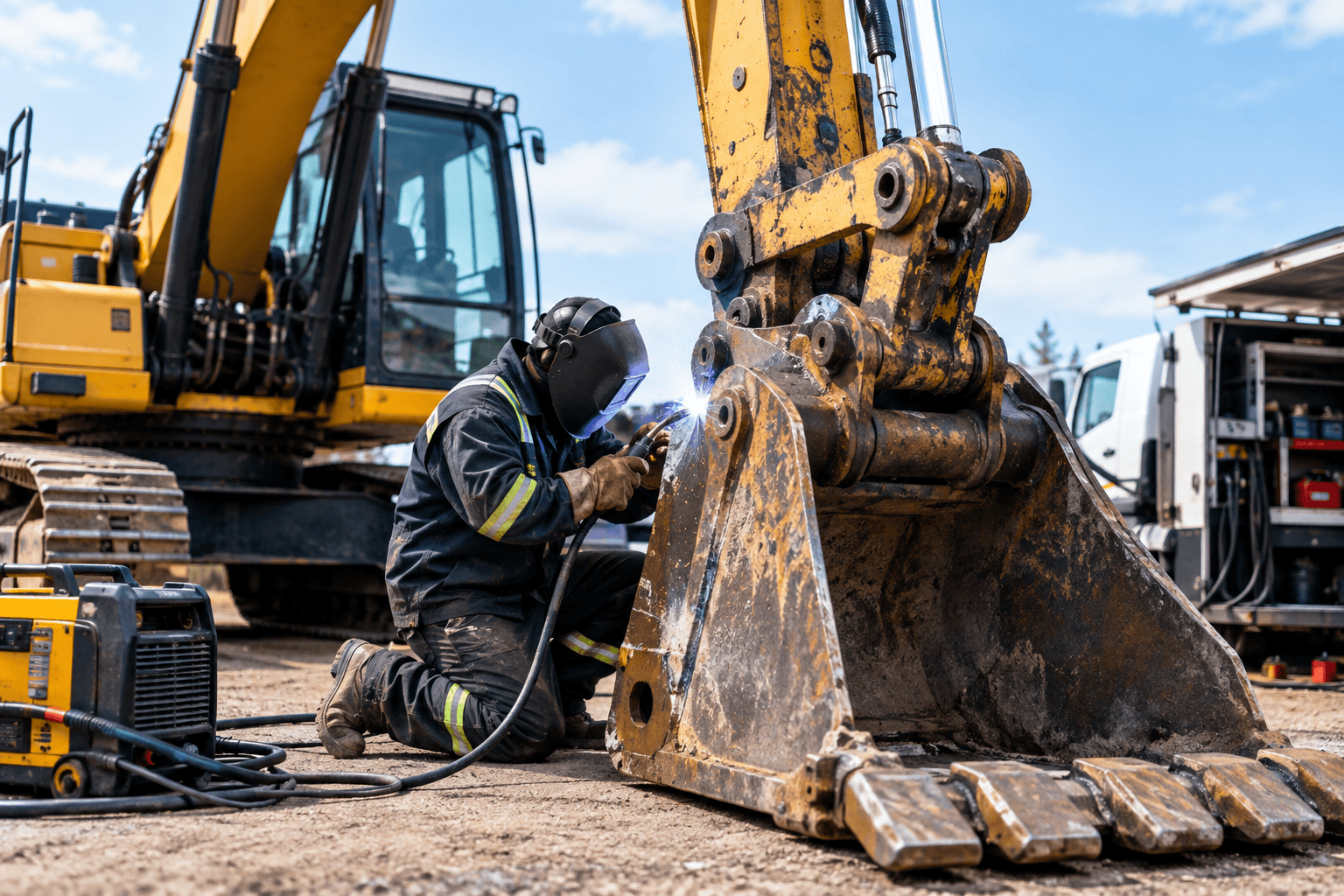
When an excavator bucket cracks or a boom weld snaps mid-shift, the whole site feels it. Digging stops. Schedules slip. Someone has to decide, fast, whether the machine can be patched where it sits or needs a ride to a shop. Trucking a forty-thousand-pound excavator onto a trailer just to fix a six-inch crack rarely makes sense, and often it isn’t necessary at all. That’s the gap mobile heavy equipment repair fills.
A qualified welder drives out, looks the damage over, and in plenty of cases finishes the job without the machine ever leaving the site. Not every crack qualifies for field welding, though. A responsible repair starts with an honest look at the damage, not an assumption that anything can be patched wherever it happens to be sitting.
Why Excavator Buckets and Booms Develop Damage
An excavator bucket works against hard soil, rock, demolition debris, and repeated loading through its cutting edge, teeth, adapters, side plates, and shell. Abrasion slowly removes steel from high-wear areas. A hard impact may bend a corner or start a crack. Then each digging cycle puts more force through that weak spot. Vibration and metal fatigue can turn a small defect into a broken weld or an open crack.
Booms face a different kind of demand. They are major load-bearing structures that transfer force between the machine and its attachment. Cracks may appear near brackets, pin bosses, mounting points, reinforcement transitions, or earlier repair sites. Overloading, misalignment, corrosion, poor previous welding, and difficult ground conditions can all play a part.
Wear damage and structural cracking aren’t the same repair problem. A worn cutting edge may need replacement or fabrication, while a cracked boom calls for a close review of crack direction, nearby metal, distortion, loading, and existing welds. Welding over a visible defect without finding its cause can leave the real failure in place.
Excavator Boom Damage: What Needs Attention
Boom repairs deserve more caution than bucket work, since the boom carries the machine’s main structural load. Cracks near high-stress zones, damaged welds around brackets and mounting points, worn pin and boss areas, reinforcement plates that already failed once, any bending or twisting visible to the eye: all of it needs a careful look before a torch or welder touches the metal.
A crack that looks small on the surface can run much deeper into the plate than it appears, and welding shut only the visible portion, without checking how far it actually travels, is a common way for a repair to fail again within weeks.
Can an Excavator Bucket Be Repaired On-Site?
Yes, in many cases, excavator bucket damage can be repaired on-site, depending on the material, how extensive the damage is, how accessible it is, and what procedure the fix requires.
Cracked plates, broken welds, damaged brackets, worn mounting areas, and localized fabrication work are all things a mobile welder can reasonably handle in the field.
Buckets sit low, close to the ground, so access is usually manageable. That’s what makes on-site excavator bucket repair such a practical option for day-to-day breakdowns.
Can an Excavator Boom Be Welded On-Site?
Some boom repairs can be finished in the field, but the call takes more scrutiny than a bucket job does. A welder has to weigh the crack’s location and length, whether it’s still spreading, how thick and sound the surrounding material is, how accessible the area is with the boom sitting in its current position, whether existing reinforcement is tangled up in it, and what loads the component will face once it’s back at work.
Manufacturer guidance matters here too, and for deeper structural cracking, engineering input may be the right call before any welding starts. This article won’t walk through a step-by-step boom repair procedure, because that decision genuinely depends on what a trained eye finds in person, standing next to the machine.
What On-Site Heavy Equipment Repair Involves
The work starts with an inspection of the visible crack, broken weld, wear pattern, deformation, and nearby components. The goal is to find where the damage began and determine whether it has reached adjacent plates, brackets, bosses, or reinforcement. Photos, measurements, operating history, and details about earlier repairs can help define the job.
Next comes the repair decision. The work may involve localized welding, fabrication, reinforcement, component replacement, or a separate engineering or mechanical assessment. The area must be made accessible and prepared by removing soil, grease, paint, rust, and loose metal. Damaged material may also need to be removed. This preparation isn’t cosmetic. Contamination or unsound base metal can weaken the finished repair.
The welding method depends on the base metal, thickness, component design, work location, and site conditions. Heavy equipment parts may use different steel grades, hardness levels, or wear-resistant materials. Earlier welding can also change how nearby steel responds to heat. A qualified professional chooses the repair method with those details in mind instead of treating every excavator as if it were built from identical steel.
Once welding or fabrication is complete, the repair should be checked for visible defects, incomplete areas, distortion, and fit. Structural or safety-sensitive work may call for further inspection. Pins, bushings, brackets, attachment movement, and clearances may need to be checked too. The machine should return to service only after the appropriate checks are complete.
Excavator Bucket Repair Compared With Boom Repair
| Repair area | Typical damage | Important considerations | On-site suitability |
|---|---|---|---|
| Bucket shell | Cracks, wear, broken welds | Remaining thickness and nearby wear | Often potentially suitable |
| Side plates | Cracking or abrasion | Damage extent and plate condition | Often potentially suitable |
| Cutting edge | Wear or deformation | Component condition and replacement needs | Depends on repair scope |
| Bucket mounting area | Cracks or distortion | Alignment, pins, and loading | Needs careful assessment |
| Boom | Structural cracks or damage | High loads, stress, and material condition | Needs careful assessment |
| Boom brackets and bosses | Cracks, wear, deformation | Alignment and load transfer | Case-specific |
| Reinforcement areas | Fatigue or recurring cracks | Failure cause and stress pattern | Case-specific |
A fabrication shop may be the better choice when the job involves extensive fabrication, machining, component removal, controlled conditions, or specialized inspection.
On-site heavy equipment repair is most useful when the machine or component can stay safely positioned and the work can be completed with proper access and equipment.
Repair, Replacement, Reinforcement, and Material Choice
When should an excavator bucket be replaced instead of repaired?
Replacement is often the better option when wear has removed a substantial amount of material, the bucket is badly distorted, cracks are widespread, previous repairs have failed more than once, or the remaining service life is short. The intended work matters too. A bucket used in abrasive aggregate may call for a different decision than one used in lighter soil.
Reinforcement isn’t automatically the answer
A plate placed over damaged steel can move stress into a neighboring section, add unwanted weight, create a new stress concentration, hide an active crack, or interfere with attachment movement. Reinforcement should match the damage pattern, component design, and expected loads. Boom work may require engineering input or manufacturer guidance.
Identifying the base metal matters just as much
Excavator buckets, booms, brackets, and wear parts may use different steel grades, thicknesses, hardness levels, heat treatments, and abrasion-resistant materials. Earlier welding can affect the condition of nearby steel. For that reason, excavator welding Toronto professionals and other mobile welding providers should inspect the part before recommending a method. Material verification is safer than guessing from appearance.
On-site Welding, Downtime, and Toronto GTA Service
Mobile heavy equipment repair can reduce disruption by bringing welding and fabrication closer to the machine. It may eliminate unnecessary transport, reduce removal and reinstallation work, and let a large component stay installed when conditions allow. That can help at construction sites, demolition projects, roadwork, landscaping operations, industrial properties, equipment yards, farms, and rural GTA locations.
| Consideration | On-site repair | Shop repair |
|---|---|---|
| Large equipment | No major transport required | Requires transportation |
| Job-site breakdown | May reduce handling and delay | Transport may add disruption |
| Remote equipment | Practical in suitable situations | More difficult to arrange |
| Large components | May remain installed | May require removal |
| Controlled conditions | More limited | Major advantage |
| Complex fabrication | Case-specific | Often better suited |
Businesses looking for mobile welding Toronto or heavy equipment welding GTA services should share the excavator make and model, affected component, close-up and wider photos, approximate dimensions, known material information, how the damage occurred, repair history, job-site location, access details, and whether the machine is operational. Those details help a mobile welder judge whether an on-site visit is practical.
Welding may not restore the entire equipment system. The job could also involve replacing pins or bushings, hydraulic work, machining, alignment, nondestructive testing, manufacturer specifications, or engineering assessment. Metal repair and complete machine restoration are connected, but they aren’t the same task.
Definition: On-site heavy equipment repair is the inspection, preparation, welding, fabrication, or component service performed at a machine’s location when the damage, access, materials, and safety conditions make field work appropriate. It covers the repair process itself, not an automatic finding that the complete machine is ready to operate.
Frequently Asked Questions
What should I do if an excavator boom develops a crack?
Stop using the machine and arrange an assessment by a qualified heavy equipment repair. Don’t assume the crack ends where the visible line stops. Continued loading can carry the damage into a bracket, boss, weld, or nearby plate.
Can broken excavator brackets be welded?
Some brackets can be repaired through welding or fabrication, but alignment, attachment movement, base-metal condition, and load transfer must be checked first. A bracket beside a pin or boom connection may need much more than a visible weld repair.
How does mobile welding reduce excavator downtime?
It can reduce transport, removal, and reinstallation work by bringing qualified welding and fabrication services to the equipment. The actual time saved depends on the damage, access, preparation, inspection, and any mechanical or engineering work that follows.
Can heavy equipment welding be done in the field?
Yes, field welding is possible for suitable components and site conditions. Structural boom damage, severe deformation, extensive wear, and failures involving alignment or major load paths require careful assessment before anyone selects a repair method.
For heavy equipment repair in Toronto and the GTA, contact a qualified mobile welding service with equipment details, damage photos, and the job-site location. A proper assessment can separate a practical field repair from a situation requiring shop work, replacement, or further technical review.

RS Welding
" Raj and Khushmeet lead RS Mobile Welding Service with 25+ years of experience delivering expert welding and fabrication across Toronto and the GTA. Backed by Canadian Welding Bureau certification, their team handles everything from emergency repairs to custom metal work with precision, safety, and reliability. When you need mobile welding done right, RS gets it done right."