
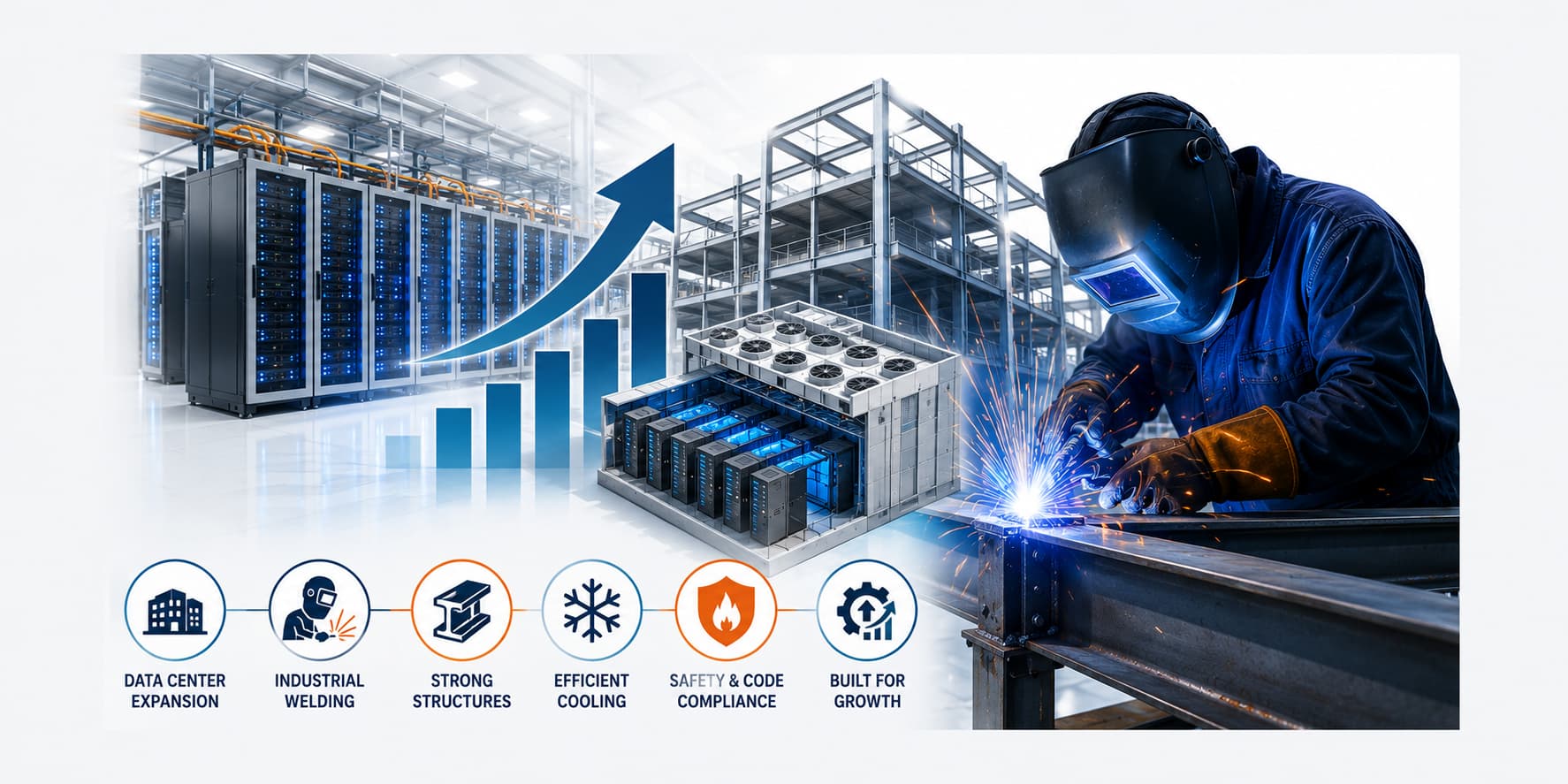
Drive through Milton, Markham, Etobicoke, or the industrial areas surrounding Toronto, and there’s a good chance you’ll pass land being cleared for a new data center. In other cases, the properties are already being marketed to major technology companies and developers. What looks like another commercial project from the road often represents a massive investment in digital infrastructure.
Ontario is in the middle of a quiet hyperscale construction boom. Demand for cloud computing, AI workloads, and data storage continues to grow, driving a steady pipeline of new facilities across the GTA and Southern Ontario. While most people never notice these projects, contractors, engineers, and industrial welding professionals see the signs everywhere.
Behind every data center is a complex industrial construction project. Structural steel, mechanical systems, cooling infrastructure, generators, fuel lines, and pipe networks all require precision welding and fabrication. This is where experienced industrial welding services become essential.
From structural steel connections and equipment supports to piping systems and field modifications, industrial welding contractors play a critical role throughout construction and commissioning. These facilities operate on aggressive timelines, which often requires on-site industrial welding services to complete work directly on-site without delaying other trades.
Data Center Construction and Maintenance: Why Welding Services Are Essential
Whether it’s installing backup generator systems, welding process piping, fabricating support frames, or making last-minute modifications, skilled industrial welders help keep these billion-dollar projects on schedule.
As more hyperscale and colocation facilities break ground across Ontario, demand for reliable industrial welding services in Toronto and the GTA will continue to rise right alongside the province’s growing digital economy.
The province now has interest in developing as much as 6,500 MW of new data center capacity, about 30 percent of Ontario’s current peak electricity load. Toronto alone reached roughly 312 MW of operational capacity in 2025, with a construction pipeline that nearly doubled to 236 MW in the first half of that year.
At least 15 hyperscale projects are proposed across the province with a combined capacity north of 2,200 MW. Microsoft has committed close to $7.5 billion to Canadian cloud and AI infrastructure, with its first new facility expected online in late 2026.
Every one of those numbers represents steel that needs to go up, piping that needs to go in, and a welder standing somewhere in the middle of it. That’s the part of the story that doesn’t make the real estate headlines, but it’s where contractors like us spend our days.
Why Data Centers Need So Much Welding in the First Place
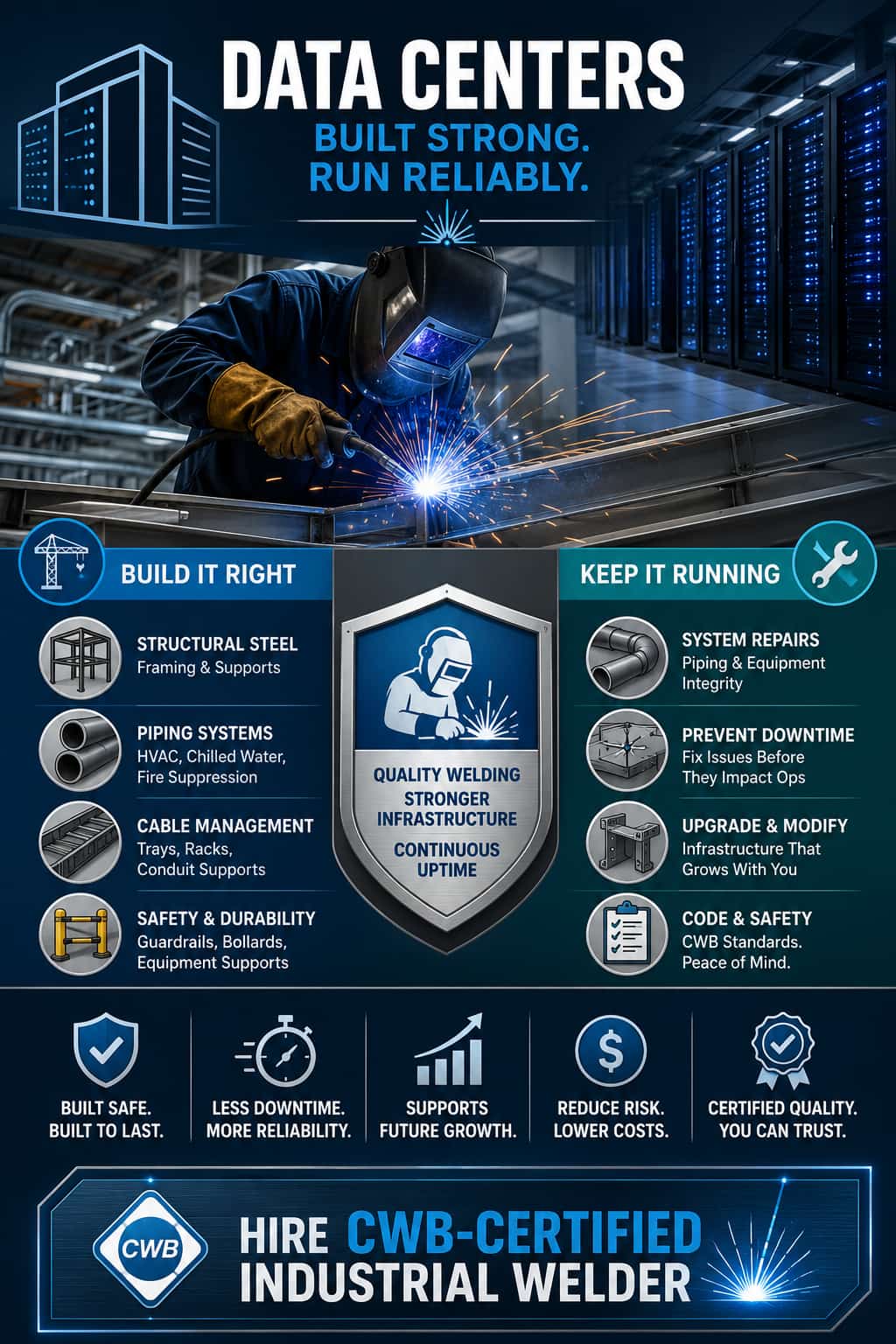
A data center reads as a tech facility from the outside. Underneath the raised floors and server racks, it’s an industrial building with the same bones as a manufacturing plant, structural steel, mechanical piping, and fire protection systems, all of it welded and inspected before a single server gets plugged in.
The welding work typically falls into a few categories:
- Structural steel and reinforcement for the building frame, mezzanines, and equipment platforms
- Rack and rooftop unit support, often requiring reinforcement of existing joists when a building wasn’t originally designed to carry that load
- Piping for cooling loops, generator fuel lines, and fire suppression, all of which need leak-free, code-compliant joints
- Custom fabrication for cable tray supports, containment frames, and equipment-specific brackets that off-the-shelf hardware doesn’t cover
- On-site modifications when field conditions don’t match the drawings, which happens more often than anyone admits on a compressed schedule
None of this is decorative work. A weak weld on a rack support or a leaking joint on a fuel line isn’t a minor fix later, it’s downtime, a safety issue, or both.
The Expansion Is Pulling Demand Into the GTA Specifically
Most of this growth isn’t happening in some far-off industrial park nobody drives through. It’s landing directly in the GTA’s backyard. Cushman & Wakefield’s research shows information technology load under construction in Toronto jumped from 33 MW in 2021 to 120 MW in 2024, then to 236 MW pre-committed in the first half of 2025 alone.
CBRE has tracked cloud providers paying record prices for large sites in Etobicoke and Vaughan to build their own campuses rather than lease space, which tells you how fast the timeline pressure is building.
For welding contractors, that shift changes the kind of work coming through the door. It’s less about small commercial jobs and more about structural erection, mechanical room fabrication, and fast-turnaround field welding on sites where multiple trades are working the same floor at once.
Shops that can only handle off-site fabrication start losing ground to crews that can mobilize fast, bring their own equipment, and adjust mid-project when a drawing doesn’t match what’s actually on-site.
What Makes a Welding Contractor Ready for This Kind of Work
Not every welder who can lay a clean bead is equipped for a data center job site. A few things tend to separate contractors who are ready for this work from those who aren’t:
- CWB certification. Canadian Welding Bureau certification confirms a welder and shop meet recognized national standards, the baseline most general contractors and engineers will ask for before they hand over a drawing.
- CSA standards compliance. Standards like W47.1 (fabrication of steel structures) and W59 (welded steel construction) govern how structural welds need to be performed and documented on a commercial or industrial project.
- Insurance and WSIB coverage. Data center construction sites are active, multi-trade environments. Anyone on-site needs to carry the right coverage, full stop.
- Range of materials and methods. Data center mechanical rooms mix carbon steel, stainless steel, and sometimes plastic piping (HDPE or PVC) for cooling or containment systems. A contractor who can move between MIG, TIG, stick, and plastic welding without subcontracting half the job out is worth more on a fast-moving site.
- Fabrication shop access. Some components are better built off-site and delivered ready to install. A contractor with both a certified fabrication shop and a mobile field crew can move work between the two depending on what the schedule actually needs.
Questions Worth Asking Before You Hire
If you’re a contractor, project manager, or facilities team scoping welding work for a data center build or retrofit, a short list of questions tends to separate the contractors who are ready from the ones who aren’t:
- Can you show current CWB certification and recent inspection or weld test records?
- Have you worked on industrial or commercial mechanical rooms before, not just residential repairs?
- Can your crew handle structural steel, piping, and custom fabrication on the same project, or will parts of it get subcontracted?
- Do you have both shop and mobile field capability, in case the schedule shifts mid-project?
- Can you respond on short notice if something needs repair once the facility is operating?
A contractor who answers all five without hesitation is the one worth putting on the bid list.
Why Timelines Are Tighter Than They Used to Be
Hyperscale clients don’t build on the same schedule a typical commercial project follows. Land deals close fast, power allocation gets secured before construction even starts, and the pressure to reach “ready for service” status shows up everywhere downstream, including the trades.
Yondr’s Toronto facility is a good example of how this plays out. The company broke ground on its first Canadian data center in January 2025 on a 4.5-acre site, and the 27 MW facility is on track to reach ready-for-service status by mid-2026. That’s a tight runway for a three-storey colocation building with a closed-loop cooling system, which means every trade involved, including structural and mechanical welding — was working against a schedule with very little slack built in.
This is the environment a lot of welding contractors aren’t set up to handle. A shop that builds components off-site and ships them out for installation weeks later can’t always keep pace when a commissioning date moves up or a structural detail changes mid-build. Crews that can fabricate, deliver, and weld on the same timeline — adjusting in the field when something doesn’t match the drawing — tend to be the ones general contractors call back for the next phase.
It’s also why emergency and after-hours availability matters more on these projects than it might on a typical commercial job. Data centers don’t get to pause operations for a repair once they’re live, and even during construction, a delay on one trade tends to cascade into delays for everyone scheduled after it. A welding contractor that can respond on short notice, rather than slotting a job in whenever the calendar allows, protects the rest of the schedule for everyone else on-site.
Where RS Mobile Welding Fits Into This Growth
RS Mobile Welding Services has been working out in Toronto and surrounding GTA since 1997, which means the shop has been through more than one construction cycle in this region. The crew is CWB certified, fully insured, and equipped to move between in-shop fabrication and on-site field welding depending on what a project needs, structural steel, stainless steel, custom metal fabrication, and plastic welding for HDPE and PVC piping systems all fall inside that range.
That mix matters more now than it did a few years ago. Data center projects don’t usually need just one type of welding. They need steel erected, piping run, brackets fabricated, and the occasional field fix handled fast when something doesn’t line up, often all within the same site visit.
The Bottom Line
Ontario’s data center expansion isn’t a future trend anymore. It’s already reshaping how much welding work is moving through the GTA, and it’s raising the bar for what “qualified” needs to mean on a job site.
If your project involves structural steel, mechanical piping, or fabrication tied to data center construction or retrofit work anywhere in Toronto or the GTA, get in touch with RS Mobile Welding Services or call (416)-825-2956 to talk through the scope.

RS Welding
" Raj and Khushmeet lead RS Mobile Welding Service with 25+ years of experience delivering expert welding and fabrication across Toronto and the GTA. Backed by Canadian Welding Bureau certification, their team handles everything from emergency repairs to custom metal work with precision, safety, and reliability. When you need mobile welding done right, RS gets it done right."