
24
Jun
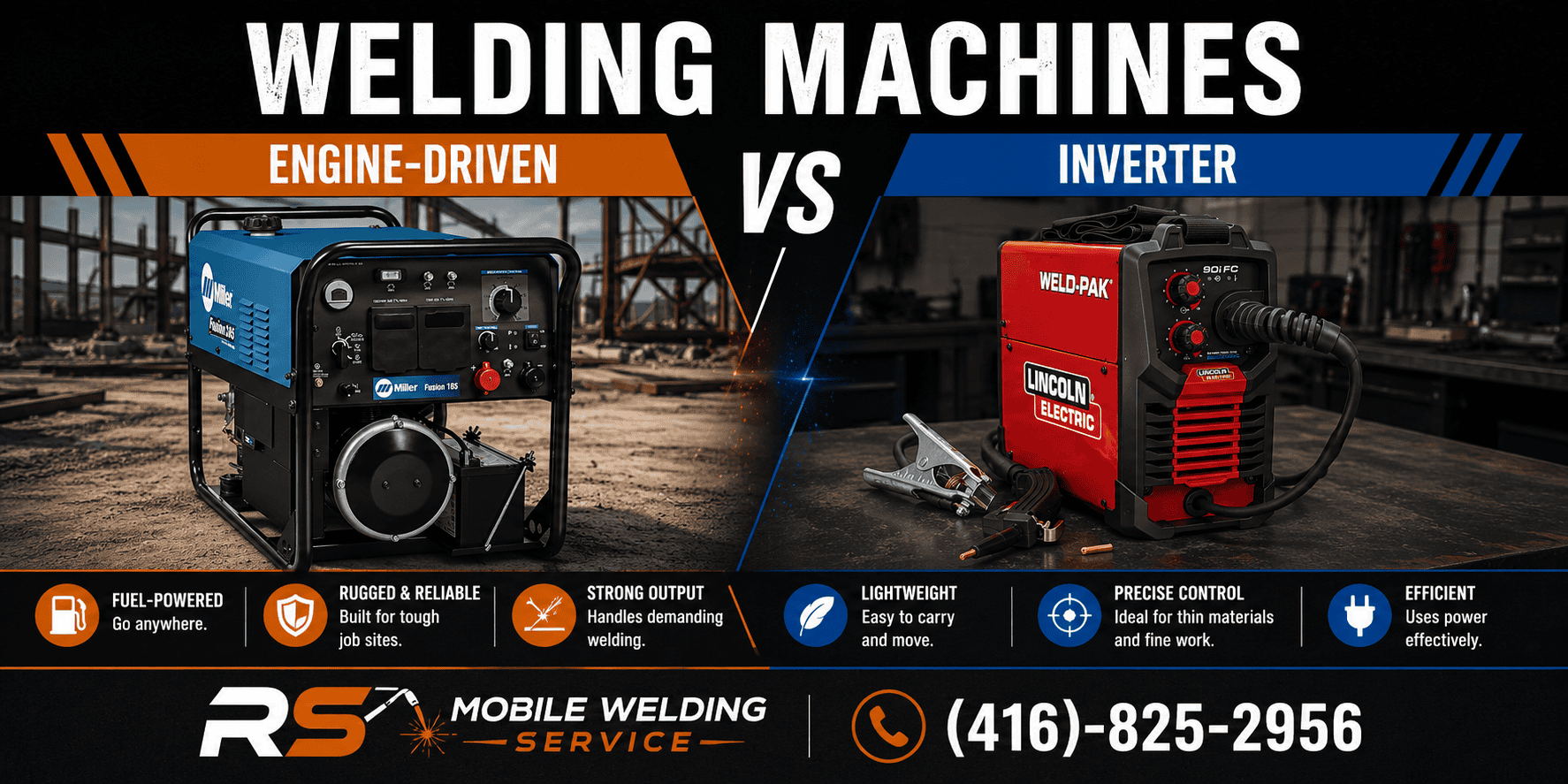
On-site welding in the GTA is not a controlled shop environment. Crews move between industrial plants in Mississauga, construction zones in Toronto, logistics hubs in Brampton, and infrastructure sites across Vaughan and Hamilton. Each location brings different constraints, and equipment choice directly affects speed, cost, and job quality. Two welding machine types are popular for on-site welding setups today: engine-driven welding machines and inverter welding machines. Both are widely used across Ontario, but they solve different problems in the field.
Engine-Driven vs Inverter Welding Machines: What GTA Contractors Use for On-Site Welding Jobs
Contractors don’t choose based on specs alone. They choose based on downtime risk, job conditions, and how much flexibility they need when things don’t go as planned.
Every job brings a different constraint: unstable power, restricted access, weather exposure, or tight shutdown windows. Equipment decisions are not made on preference alone. They are made on whether the crew can complete the weld without downtime.
That’s where the choice between engine-driven welding machines and inverter welding machines becomes critical. Both are widely used across Ontario’s mobile welding industry. But they solve very different operational problems once they leave the shop.
Mobile welding in the GTA is not repetitive work. One day may involve emergency repair at a Mississauga manufacturing plant. The next may involve steel reinforcement on a Toronto high-rise or maintenance welding in a Hamilton steel facility.
Each environment changes three core variables:
- Power availability and stability
- Space and mobility restrictions
- Weld type and material thickness
Older industrial zones across Ontario often run on legacy electrical systems. Even when power is available, voltage drops under load are common during heavy fabrication work. That alone can interrupt productivity if the wrong machine is deployed.
Field experience shows one consistent truth: downtime is more expensive than fuel, equipment, or labor inefficiency. Contractors prioritize continuity of work over theoretical efficiency. This is why equipment selection is treated as a workflow decision, not a technical comparison.
Engine-Driven Welding Machines: Built for Field Independence
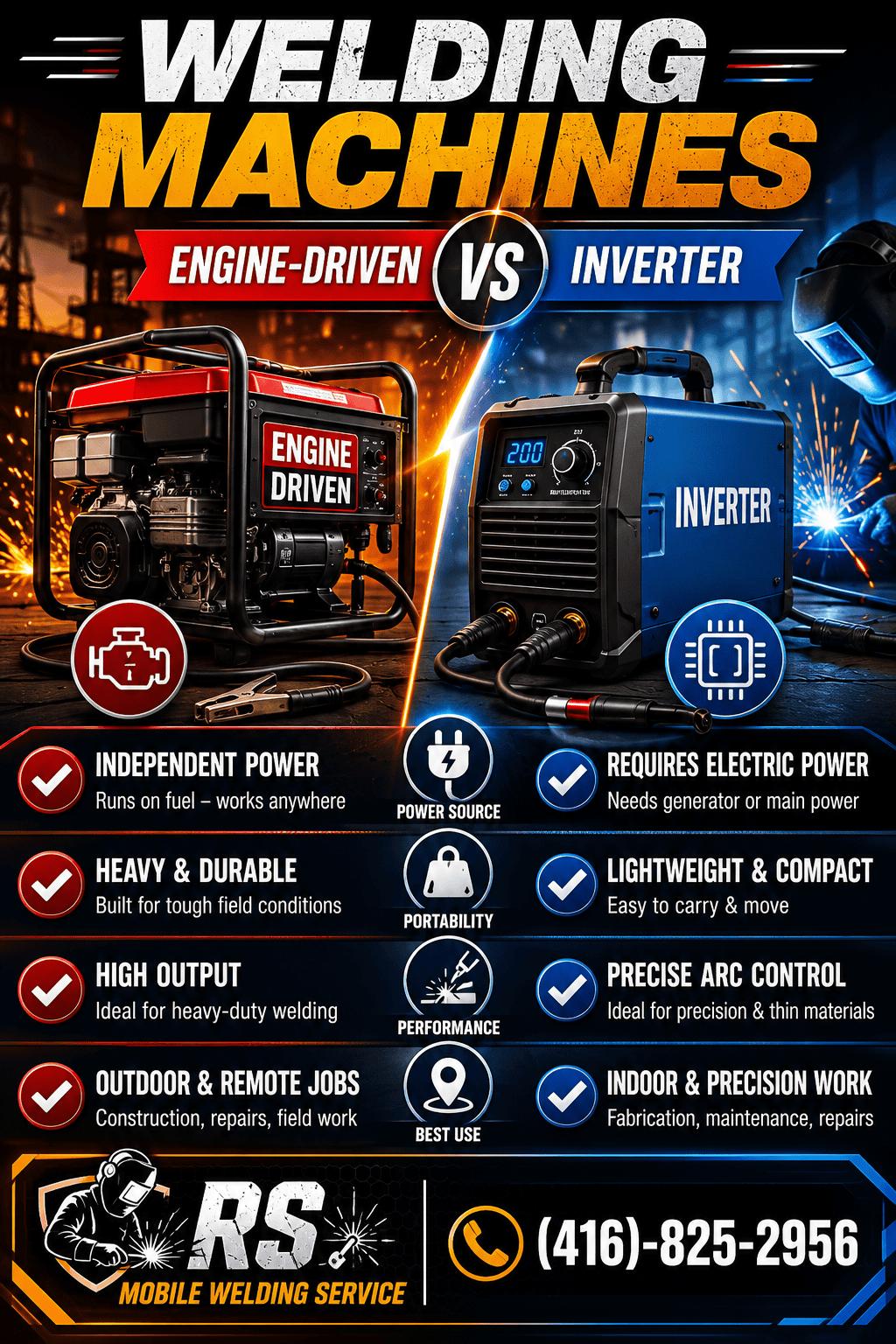
Engine-driven welding machines operate using a fuel-powered engine that generates welding output internally. This removes dependency on external electrical supply, making them ideal for uncontrolled job environments.
In mobile welding across the GTA, these units are typically mounted on service trucks or trailers to support full-day field operations.
Where they are actually used in Ontario field work
Contractors rely on engine-driven machines in situations such as:
- Structural steel repair on active construction sites
- Highway, bridge, and infrastructure maintenance work
- Pipeline welding and utility repairs in remote access zones
- Outdoor fabrication and heavy equipment repair
- Emergency breakdown welding where time sensitivity is critical
These are environments where power access cannot be assumed or guaranteed.
How they perform under real operating conditions
Field performance matters more than specifications on paper.
Engine-driven machines (operated by gasoline) remain preferred in heavy-duty GTA applications because they:
- Deliver stable output under continuous load cycles
- Perform reliably in cold-weather conditions common in Ontario winters
- Operate independently without voltage dependency or external stabilizers
- Handle thicker materials without frequent interruption or overheating breaks
In structural welding, consistency over long runs often determines job quality. Engine-driven systems maintain that consistency better under unpredictable field stress.
Practical limitations contractors work around
Despite their reliability, these machines come with trade-offs. Fuel consumption is continuous during operation, which increases operating cost over long shifts. Maintenance also involves mechanical servicing, which is more frequent than inverter systems.
Noise and emissions can limit usage in enclosed or regulated environments, especially in downtown Toronto or indoor industrial facilities.
However, most contractors accept these limitations because they eliminate the bigger risk: lack of power on site.
Inverter Welding Machines: Precision Control in Compact Systems
Inverter welding machines use electronic power conversion to regulate output efficiently. They are significantly smaller and lighter than engine-driven systems, which makes them highly mobile.
Unlike engine-driven units, they depend on a stable external power source, either from a generator, hybrid truck system, or job-site electrical supply.
This dependency shapes where and how they are deployed in the field.
Where inverter systems are used across GTA job sites
Inverter machines are commonly used for:
- Precision fabrication and repair work in controlled environments
- Stainless steel and thin material welding
- Indoor industrial maintenance inside plants and warehouses
- Commercial building repair with strict access limitations
- Tight-space mobile welding where mobility matters more than raw output
They are particularly useful in environments where power is already stabilized and workspace constraints are tighter.
Why experienced welders prefer them for precision work
Inverter systems provide tighter arc control. That level of control reduces distortion on thin metals and improves weld finish consistency.
They also respond quickly to adjustments, allowing welders to adapt settings mid-job when material thickness or joint geometry changes.
From a field perspective, that responsiveness reduces rework and improves finish quality in repair-heavy jobs.
Their compact footprint also allows mobile setups to carry multiple units or integrate them into smaller service rigs without sacrificing truck capacity.
Real operational constraints in Ontario field use
Inverter machines are sensitive to power quality. Voltage fluctuations on older industrial systems can affect arc stability and output consistency.
They also require proper cooling and duty cycle management. Extended heavy welding can push them beyond optimal thermal limits if not properly sized for the job.
Because of this, inverter systems are rarely used as the sole machine in full-service mobile welding operations.
How GTA Contractors Actually Make the Choice in Practice
In real-world mobile welding operations, machine selection is not theoretical. It follows job conditions and risk control logic.
Power availability determines primary machine choice
- If power is uncertain or unavailable, engine-driven machines are deployed by default.
- If power is stable and controlled, inverter systems become viable and often preferred for precision work.
Job type determines equipment pairing
- Heavy fabrication and structural reinforcement lean toward engine-driven systems.
- Fine repair work, stainless welding, and controlled indoor environments lean toward inverter systems.
Mobility vs endurance trade-off
- Inverter machines reduce truck weight and improve fleet mobility efficiency across multiple daily stops in GTA industrial zones.
- Engine-driven machines increase load but extend operational independence and reduce reliance on job-site infrastructure.
Downtime risk is the deciding factor
- Contractors consistently prioritize reducing downtime over improving theoretical efficiency.
- Engine-driven systems reduce downtime caused by power failure.
- Inverter systems reduce downtime caused by transport limitations or setup constraints.
- Both reduce downtime differently, depending on context.
What Professional Mobile Welding Trucks in the GTA Actually Use
Most experienced mobile welding operations do not rely on a single machine type.
Instead, they use hybrid configurations designed for flexibility.
A typical GTA mobile welding setup includes:
- Engine-driven welding unit for structural and heavy-duty work
- Inverter welding machine for precision and indoor tasks
- Auxiliary generator or integrated truck power system
- Full fabrication kit including cutting, grinding, and gas systems
This combination allows welders to adapt without returning to base, which is critical in high-volume industrial zones.
In fast-paced areas like Mississauga and Toronto industrial corridors, this adaptability directly improves job completion rates.
Maintenance, Reliability, and True Cost Considerations
Equipment cost alone does not reflect real operational cost in mobile welding.
Engine-driven machines require:
- Engine servicing and fuel system maintenance
- Regular mechanical inspections
- Wear component replacement over time
Inverter machines require:
- Electrical system protection and monitoring
- Cooling system maintenance
- Stable power conditions to prevent performance issues
The key difference is failure type. Engine-driven failures are typically mechanical and gradual. Inverter failures are often linked to electrical instability and can occur more abruptly in poor conditions.
This is why redundancy is common in professional fleets.
Ontario Job Site Regulations and Environmental Constraints
Regulations across Ontario increasingly influence equipment choice.
Engine-driven machines can face restrictions in enclosed, indoor, or noise-sensitive environments due to emissions and sound output.
Inverter systems perform better in:
- Indoor industrial plants
- Commercial and institutional buildings
- Residential-adjacent construction zones
- Low-emission compliance environments
Contractors often switch machines based on compliance needs rather than preference.
Why Many GTA Contractors Choose Mobile Welding Services Instead of Buying Equipment
Owning, maintaining, and deploying a dual-system welding setup requires capital investment, technical knowledge, and ongoing maintenance planning.
Many contractors and facility operators choose to hire mobile welding services instead.
The advantage is operational simplicity: the provider selects the right equipment based on job conditions instead of forcing one system into all scenarios.
Welding companies like RS Mobile Welding Service operate with field-adapted equipment strategies designed for GTA industrial conditions. That includes matching machine type to job environment, material requirements, and access constraints.
This reduces downtime risk and avoids misalignment between equipment and job demands.
Final Takeaway for GTA Contractors
Engine-driven and inverter welding machines are not competing technologies. They are complementary tools used for different operational conditions.
Engine-driven systems dominate when:
- Power access is unreliable or unavailable
- Work involves heavy structural welding
- Long continuous duty cycles are required
- Job sites are remote or exposed
Inverter systems dominate when:
- Precision and weld control are critical
- Space and weight constraints exist
- Power supply is stable and controlled
- Work involves light to medium fabrication
Most experienced GTA contractors do not choose one over the other. They combine both within a single operational system. That combination is what allows mobile welding teams to stay productive across Ontario’s diverse and demanding industrial landscape.
People Also Asked,
- Building a Data Center? Here’s Why Industrial Welding Matters
- Aluminum Welding Market Is Growing Fast
- CSA Standards: W47.1, W47.2, W186, W55.3, W59 & A660 Explained
- Understanding Different Types of Laser Welding

RS Welding
" Raj and Khushmeet lead RS Mobile Welding Service with 25+ years of experience delivering expert welding and fabrication across Toronto and the GTA. Backed by Canadian Welding Bureau certification, their team handles everything from emergency repairs to custom metal work with precision, safety, and reliability. When you need mobile welding done right, RS gets it done right."