
13
Apr
Winning large construction projects in Canada often depends on having the right CSA stardards welding certifications. However, these requirements are rarely presented clearly and are usually buried in complex technical documents. Bidding for a large project requires welding certifications in Canada to qualify for the next steps. These requirements are not clearly listed and are often found in long technical documents. Many standards use similar or overlapping names, making them difficult to distinguish. It requires patience and quite an effort to figure out the list of certifications your company needs.
CSA welding standards in Canada, like W47.1, W47.2, W186, W55.3, W59, and A660, exist to protect building occupants and workers against sudden structural failures. These situations are possible if the welding work is done by unqualified personnel. From a business side, these standards can make a difference in winning government contracts and large commercial projects.
This blog will break down the core CSA standards to help you understand what standards to adhere to for your next project. Along with compliance guidance and a clear look at how they influence your chances of winning bids.
What Are CSA Welding Standards?
CSA standards in the welding industry define the technical standards that are developed to maintain minimum requirements for safety, quality and performance across different industries in Canada. These standards define which procedures must be documented, how work should be inspected, and how worker qualifications are verified, workers’ qualification and how the final work should be inspected.
This helps to ensure all welding meets strict safety and quality requirements before any structure is approved. Since 1947, the Canadian Welding Bureau (CWB) has been administering these standards and offering certification to companies and welders.
Therefore, when a company earns CWB certification, it means the company’s personnel qualifications, quality systems and welding procedures have been reviewed by an independent auditor. Only after their confirmation are companies liable for welding certification in Canada. However, certification should not be confused with compliance.
Even if a company meets all technical welding requirements, it doesn’t always mean it holds official third-party certification. That said, for most government and commercial projects in Canada, certification through the Canadian Welding Bureau is a basic requirement to participate.
Quick Snapshot: All Six Standards at a Glance
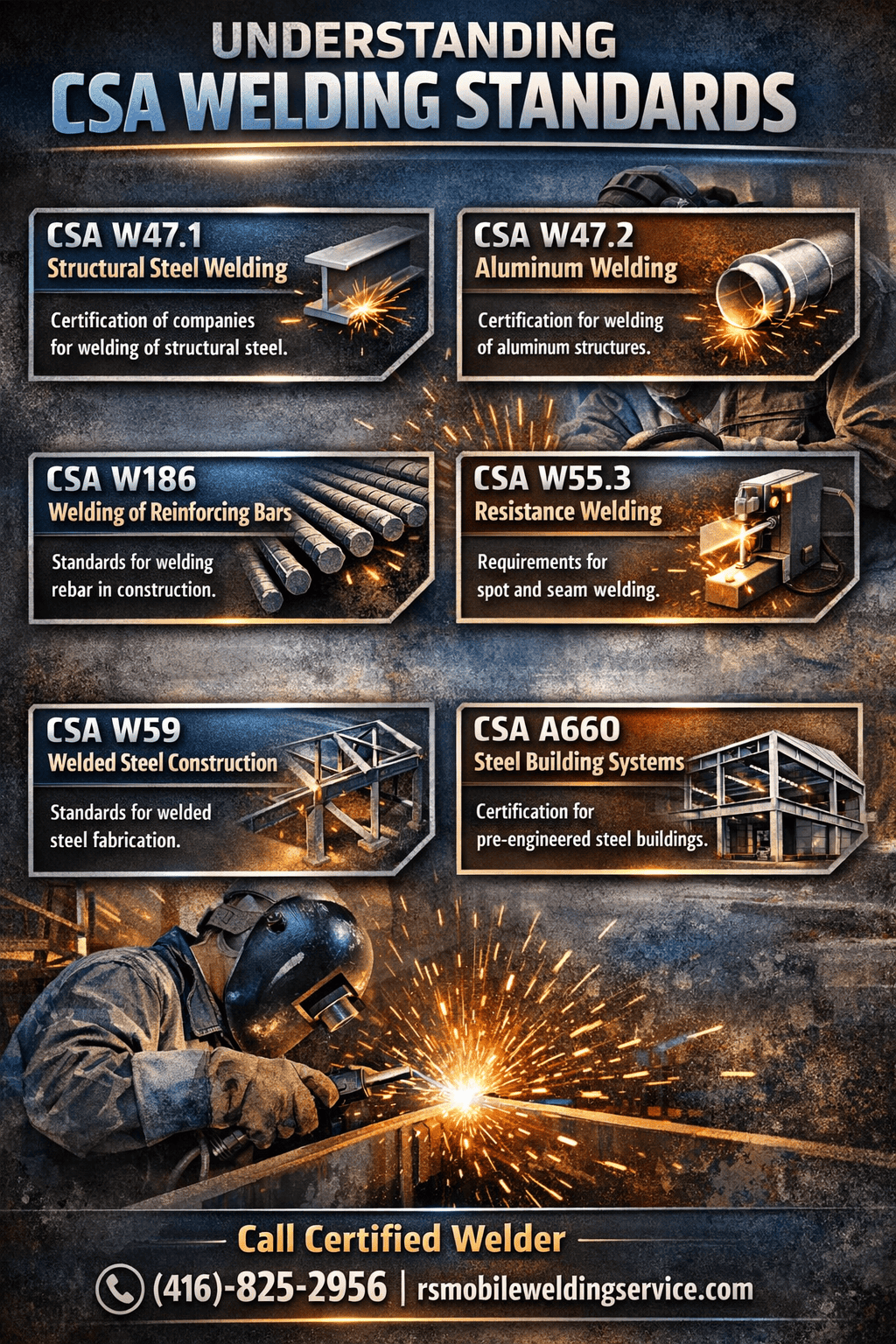
| CSA Standard | What It Governs | Who It Is For |
| W47.1 | Certification for fusion welding of steel structures | Structural steel fabricators and erectors |
| W47.2 | Certification for fusion welding of aluminum | Aluminum fabricators in aerospace, transport, and architecture |
| W186 | Welding of reinforcing bars (rebar) in concrete structures | Civil and infrastructure contractors |
| W55.3 | Certification for resistance welding of structural components | Joist and decking manufacturers, high-volume fabricators |
| W59 | Technical rules for welded steel construction | Structural engineers, fabricators, and inspection professionals |
| A660 | Quality certification for pre-engineered steel building systems | Manufacturers of pre-engineered steel buildings |
These standards do not operate in separate silos. On a typical large construction project, a company may need to comply with several of them at once. Understanding how they connect is just as important as knowing what each one requires individually.
CSA W47.1 – Certification for Fusion Welding of Steel
For structural steel welding standards, CWB certification prioritizes meeting the CSA W47.1 standard. It dictates the requirements that a company must have in place. That caters to welding procedures, qualified supervisors and a functioning quality control system. Complying with this standard is necessary to perform fusion welding on steel structures legally.
Fusion welding is the process in which the base metal is melted at the joint. The W47.1 standard does not describe how to design a weld joint. However, it makes sure that the company has qualified professionals to do the job and documented systems.
The Three Divisions: and Why They Matter
These divisions reflect a different level of in-house engineering capacity.
Division 1: The company employs a qualified Welding Engineer full-time on staff. This provides the highest level of internal technical oversight.
Division 2: The company uses a qualified Welding Engineer on contract rather than in-house.
Division 3: No Welding Engineer is required. This division typically applies to simpler or lower-complexity work.
Most of the fabricators bidding on structural steel buildings need to abide by Division 1 or 2. Division 3 is more suited for erectors or companies that are focused on fabrication work.
What Certification Actually Requires
Getting W47.1 certified is not a one-time exam. It requires a company to:
- Employ a welding supervisor with work experience in a similar field for at least five years. The professional should have passed the written exams dedicated to welding symbols, inspection methods and the W47.1 and W59 standards themselves.
- Submit Welding Procedure Specifications (WPS) and supporting data sheets for CWB Engineering review and approval before any certified work begins.
- The qualifications of a welding operator or welder should be verified through CWB-witnessed tests. Here, experience and certification are not enough to rely on the welder’s experience.
- Pass an on-site certification audit where the CWB reviews your documentation, personnel files, and actual welding operations.
For example, a steel fabricator who is building a commercial office tower in Toronto needs W47.1 certification. The person must ensure that every weld on the structural frame follows CWB-approved procedures under the supervision of a qualified individual. In case of inspection failure, the project can face costly delays.
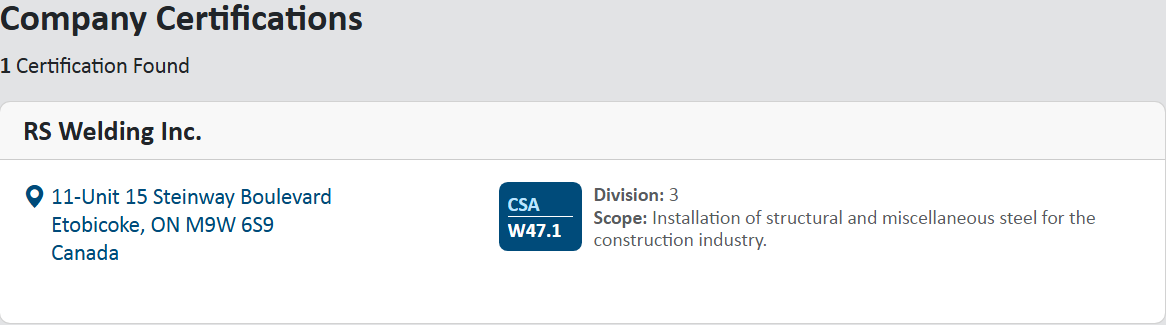
RS Mobile Welding Services is a CSA W47.1 certified welding company, delivering code-compliant, high-quality steel welding for residential, commercial, and industrial projects.
CSA W47.2 – Certification for Fusion Welding of Aluminum
Aluminum’s physical characteristics include high thermal conductivity. It means a naturally occurring oxide layer melts at a much higher temperature than the aluminum itself. If welding parameters are not tightly controlled, it risks porosity and hot cracking.
This is why CSA W47.2 standards exist, dedicated to the fusion welding of aluminum and aluminum alloys. It is also administered under the CWB and uses the same three-division structure in accordance with in-house engineering capacity. Also, you cannot self-assess aluminum welding certification based on the testing alone. You will need approval from independently witnessed welder qualification tests.
Who Needs It
CSA W47.2 certification matters across several industries where aluminum welding is safety-critical:
- Aerospace and defence: Structural aluminum assemblies where weld integrity is non-negotiable.
- Transportation: Railcar bodies, bus frames, aluminum marine vessels, and transit vehicles.
- Architectural aluminum: Curtain wall systems, canopies, and decorative structural facades.
- Industrial fabrication: Custom aluminum structures, pressure vessels, and process equipment.
For companies working with aluminum in these industries, not having W47.2 certification can be a limitation. Third-party verification in Canada sends a much stronger signal of quality and reliability than self-certification.
CSA W186 – Welding of Reinforcing Bars (Rebar)
Welding is not always about steel beams and columns alongside reinforced bars inside concrete. Rebar welding is a structural standpoint, and CSA W186 is the standard that governs it.
CSA W186 is a standard that specifically focuses on welding rebar (reinforcing steel) used inside concrete structures. It covers bar-to-bar connections and welding rebar to steel anchor parts in concrete. The welding plates, structural steel welding standards and angles are governed by W59.
A contractor working on a bridge project will require W186 certification for the rebar welding. Whereas for structural feel components, W47.1 certification is required for the same bridge. One certification does not replace the other, and assuming it does can lead to inspection failures.
Where It Applies?
CSA W186 is essential for contractors working on:
- Bridge construction and rehabilitation: Rebar splices and connection welds within bridge decks, piers, and abutments.
- High-rise buildings: Moment frame and shear wall reinforcement connections.
- Highway and transit infrastructure: Retaining walls, overpasses, sound barriers, and tunnel linings.
As of 2026, the standard has been reaffirmed, showing it remains the accepted benchmark in Canada. Non-compliance with W186 carries serious consequences.
Faulty rebar welding in concrete structures can trigger premature cracking and weaken load transfer. That can impose a worst-case outcome and significant legal consequences.
CSA W55.3 – Certification for Resistance Welding
Compared to usual arc welding, resistance welding is a different way of joining metal. In this process, the metal pieces are pressed together, and an electric current is passed through them.
At the contact point, the heat created by electrical resistance melts and fuses the metals. Spot welding is an example of this.
Here, CSA W55.3 standards are applied as a standard to meet. It dictates the requirements for the equipment used, how the welds are inspected, and how the process is controlled.
Specifically, it applies to:
- Open web steel joists: the lightweight trusses used in commercial floor and roof systems across most industrial and institutional buildings.
- Open web rigid frame members: structural framing elements in large industrial facilities.
- Roof and floor decking: the steel sheet assemblies that form the working deck in commercial construction.
Why It Matters for High-Volume Manufacturing
The CSA w55.3 standard makes sure the welding is consistent and repeatable in times of construction in high-volume production. A manufacturer producing thousands of parts can’t really inspect each weld.
This standard focuses on controlling this inspection process. That ensures the machines are properly calibrated, welding settings are documented, and regular samples are also tested. Since 1965, this standard has been around and also reaffirmed in 2023.
CSA W59 – Welded Steel Construction
CSA W59 welding code tells you about how the welding is supposed to be done. It is one of the most referenced technical standards in Canadian structural engineering. It covers fabrication, design, and inspection of welded steel connections for all infrastructure types.
What W59 covers:
- Welding processes: SMAW, SAW, GMAW, FCAW, MCAW, stud welding, and electroslag/electrogas welding.
- Connection design: joint configurations, fillet weld sizing rules, groove weld geometry, and how connections transfer loads.
- Electrode and consumable selection: filler metal matching requirements and hydrogen control classifications.
- Workmanship: surface preparation, fit-up tolerances, preheat and interpass temperature requirements, and weld repair procedures.
- Inspection and acceptance criteria: what visual inspection must cover, when non-destructive examination (NDE) is required, and what counts as an acceptable versus rejectable discontinuity.
This standard separates structures into two types. First is statically loaded structures, where the load remains steady and doesn’t change over time. Second is cyclically loaded structures (like bridges or crane systems), where the load causes ongoing stress with repetitions.
As welds behave differently under repeated stress, it is critical to recognize that cyclic loading causes fatigue. This means the small cracks can grow until failure. Due to these risk factors, the structures need more careful inspection and stricter design rules.
W59 and W47.1 Work as a Pair
W47.1 and W59 are meant to work together. Many contractors make the mistake of treating them independently, which contributes to compliance issues. W47.1 is about the company and people. It confirms that the welders and supervisors in the company are qualified and are eligible for certification. W59 is about the actual work. It focuses on the technical details of how the welding should be done.
Companies with W47.1 standard are expected to follow W59 for projects involving structural welding. If any gap between certification and practice is caught during inspection or audits, it may force the company to halt work until proper compliance is restored.
W59 is referenced in the National Building Code of Canada and is widely cited in provincial bridge and infrastructure specifications. It applies to base metals 3 mm thick and above. Further covers carbon and low-alloy steels, but excludes stainless steel, pressure vessels, and other specialized applications handled under separate codes.
CSA A660 – Certification for Steel Building Systems
CSA A660 steel building certification focuses on the quality management for companies that are building steel structures. Pre-engineered buildings are designed based on location, use, and load conditions. A660 certification confirms the company has the systems in place to handle this complexity correctly.
What A660 actually evaluates includes:
- Qualified engineering oversight and a controlled design process that applies the applicable Canadian codes for the specific building site.
- Documented materials traceability and controlled purchasing processes.
- Qualified welding and fabrication in compliance with relevant welding standards.
- Inspection and testing plans that cover production quality.
- Proper erection documentation that reaches the builder in the field.
It Is Mandatory: Not Optional
The National Building Code of Canada mandates meeting CSA A660 for building pre-engineered steel. When applying for a building permit, the proof of A660-certification plays a major role in getting approved. The Certificate of Design and Manufacturing Conformance is a key part of this certification.
This is signed by a licensed engineer and confirms that the building was properly built according to the code. A660-certified companies are audited every year by independent inspectors. This helps with ongoing quality assurance backed by third-party checks.
How These CSA Standards Actually Work Together in Canada?
On a real project, these standards do not exist in isolation. They represent different layers of the same compliance system. Walk through a typical structural steel building project:
- Design phase: The structural engineer uses CSA W59 welding code as the technical reference. This applies to joint configurations and quality requirements.
- Fabricator selection: The general contractor requires the steel fabricator to hold CSA W47.1 certification. This confirms that both qualified personnel and CWB-approved procedures are in place.
- Rebar work: For any welded rebar connections, the concrete contractor must be certified under CSA W186. This is applicable for work across a building’s foundation or concrete core.
- Joist and decking supply: The joist manufacturer must hold CSA W55.3 certification to supply resistance-welded joists and deck.
- Pre-engineered components: If a pre-engineered steel building system is specified, the manufacturer must hold CSA A660 steel building certification. They are supposed to supply a sealed Certificate of Conformance.
- Aluminum elements: Any aluminum structural work, be it curtain wall framing, canopies, or structural facades, requires a CSA W47.2 certified company.
Missing any one of these layers on a project creates a compliance gap that can stall inspections, void warranties, and expose your business to liability.
Benefits of CSA Certification for Your Business
Beyond the regulatory requirements, CSA certification delivers genuine business value:
- Government access and large-scale projects: CWB certification is a mandatory bid requirement for projects at the federal, provincial, and municipal levels.
- Credibility with engineers and project owners: Gaining certification provides empirical proof that your quality systems have been independently verified. Engineers of record are far more comfortable specifying a certified fabricator.
- Lower liability exposure: Companies with verified compliance frameworks face fewer claims linked to weld failures. This matters to gain professional liability insurance and project bonding.
- Competitive differentiation: In competitive tender markets, holding multiple relevant certifications sets you apart. This works particularly when other bidders have not made that investment.
- Better internal quality control: The certification process forces procedure approval, documentation, and personnel qualification. These habits improve consistency on the shop floor over time.
Conclusion
CSA welding standards are not just compliance requirements, they are a competitive advantage for businesses in Canada. Each standard focuses on who is qualified to wield, how the welding is done and the positioning of the system. These certifications act as proof of credibility, showcasing that the company follows strict quality standards.
If a company is unsure about which certifications it needs or wants to stay compliant, it should consult a certified expert. Getting guidance early can help avoid delays and costly compliance issues later.
Frequently Asked Questions
1. What is the difference between CSA W47.1 and CSA W59?
CSA W47.1 certifies companies for fusion welding of steel, focusing on personnel qualifications, procedures, and quality systems. CSA W59 provides technical rules for welded steel construction, including design, fabrication, inspection, and acceptance criteria. They work together: W47.1 qualifies the company; W59 governs the work. (38 words)
2. Do I need CSA W47.2 if I already have W47.1 certification?
No, W47.1 covers steel fusion welding; W47.2 is specifically for aluminum and alloys due to their unique properties like high thermal conductivity and cracking risks. Both require CWB-administered certification with welder tests and procedures, but aluminum needs separate qualifications.
3. When does CSA W186 apply to a construction project?
CSA W186 governs the welding of reinforcing bars (rebar) in reinforced concrete, including bar-to-bar splices and rebar-to-steel anchors. It applies to bridges, high-rises, highways, and infrastructure. Requires qualified supervisors, engineers, and CWB-approved procedures; does not cover general structural steel.
4. Is CSA W55.3 the same as W47.1?
No, W47.1 covers fusion welding (e.g., MIG, Stick) of steel structures. W55.3 certifies companies for resistance welding (e.g., spot, seam) of steel/aluminum in joists, decking, and frames. Focuses on process control, equipment calibration, and sampling for high-volume production.
5. Why is CSA A660 important for pre-engineered steel buildings?
CSA A660 mandates quality management for pre-engineered steel building manufacturers, verifying engineering, materials traceability, welding compliance, inspections, and site-specific design per Canadian codes. It’s required by the National Building Code; it includes annual audits and a sealed Certificate of Conformance.

RS Welding
" Raj and Khushmeet lead RS Mobile Welding Service with 25+ years of experience delivering expert welding and fabrication across Toronto and the GTA. Backed by Canadian Welding Bureau certification, their team handles everything from emergency repairs to custom metal work with precision, safety, and reliability. When you need mobile welding done right, RS gets it done right."